For the fourth time, I am back here at the seminary in Medellín, this time for a period of two months. As I wrote earlier, I have been working as an Old Testament teacher at FUSBC since September 1, 2022. This semester I am teaching courses on Biblical theology and the cultural background of the Old Testament for the master's program.
In addition to my classes, I am working every week to translate the Study Bible into Spanish for the Center for Bible Study. I am currently busy with the book of Genesis and have arrived at chapter 24. It is quite a challenge, but it is also very important to understand the richness of the Old Testament accessible to make for the people of Colombia and Latin America through the Study Bible.

Being here at the seminary gives me ample opportunity to engage with students. In my previous post, I talked about Jaïr, who was one of the first to start using the study Bible.
A conference on preaching was recently held here, where well 200 predecessors participated in. It was inspiring to hear that the study Bible is used in the exegesis of Biblical texts and that people greatly appreciate the text-by-text commentary.

It is extraordinary to consider that for many pastors, elders and students, the size of their bookshelves is often limited because books are very expensive here. Thanks to the Study Bible, 40 years of Bible research suddenly comes at your fingertips for free. Isn't that a gracious gift?

Jennifer, who is responsible for the seminary's extension work (courses in the congregation), has been actively promoting the study Bible. This is extremely good to hear. Still, I regularly get asked when the Old Testament will be available.
In many churches, the New Testament is preached more often than the Old Testament. However, there is a great need for an in-depth explanation of the first part of the Bible. This is understandable, given that the Old Testament gives considerable attention to justice and righteousness, as well as standing up for widows, orphans and strangers. Colombia is home to many vulnerable people, including more than 2 million refugees from neighboring Venezuela, and violence and injustice dominate the daily news. There is still much work to be done in this area.
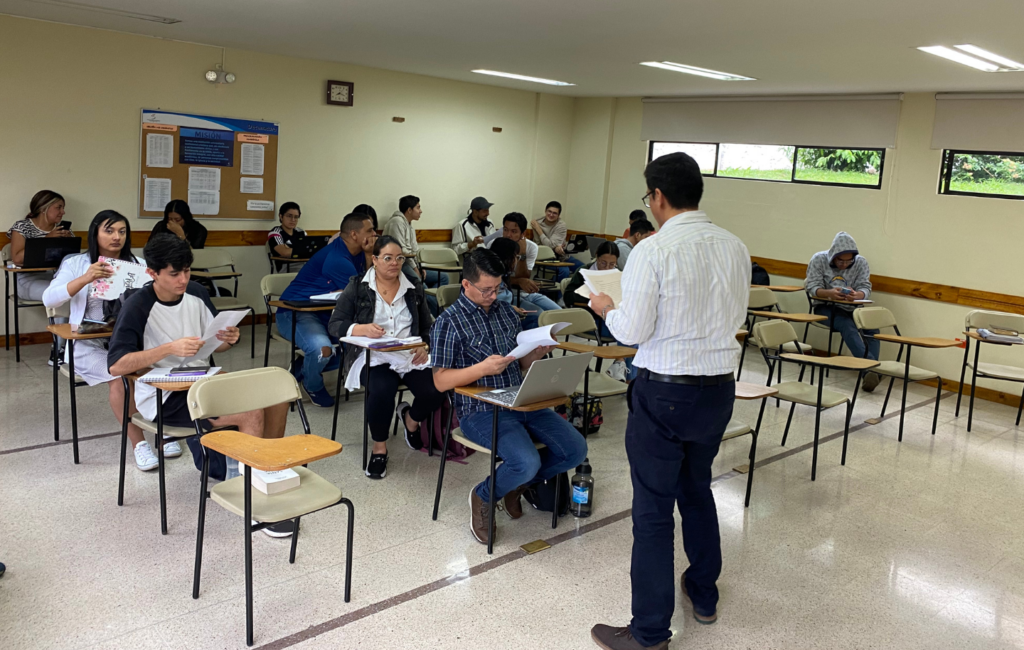
Recently, I had the honor of giving a lecture on homiletics (preaching), in which I explained as a Dutch preacher how I arrive at a sermon from a biblical text. It was wonderful to share my own preaching process with a group of 25 students. My lesson marked the conclusion of a season of preaching; all that remains for the students now is to preach a sermon as the conclusion of the course.


After my contribution to the class, I had many conversations with students about the challenges they experience in creating a sermon. The step from the text to the sermon proves to be a difficult task. Several students use the study Bible, seeing good Bible interpretation as an indispensable step on the way to a successful sermon.
Last Saturday I met Mayra, who had chosen Psalm 9, but what a tricky psalm it turned out to be to make a sermon about. I was able to help her by asking a few simple questions. In a few days it will be her turn to preach the sermon. It would have been helpful to be able to give her the commentary on Psalm 9 from the study Bible. Perhaps next time I can assist someone with this.
Dr. Gerrit Vreugdenhil
Medellín (Colombia) / Gouda