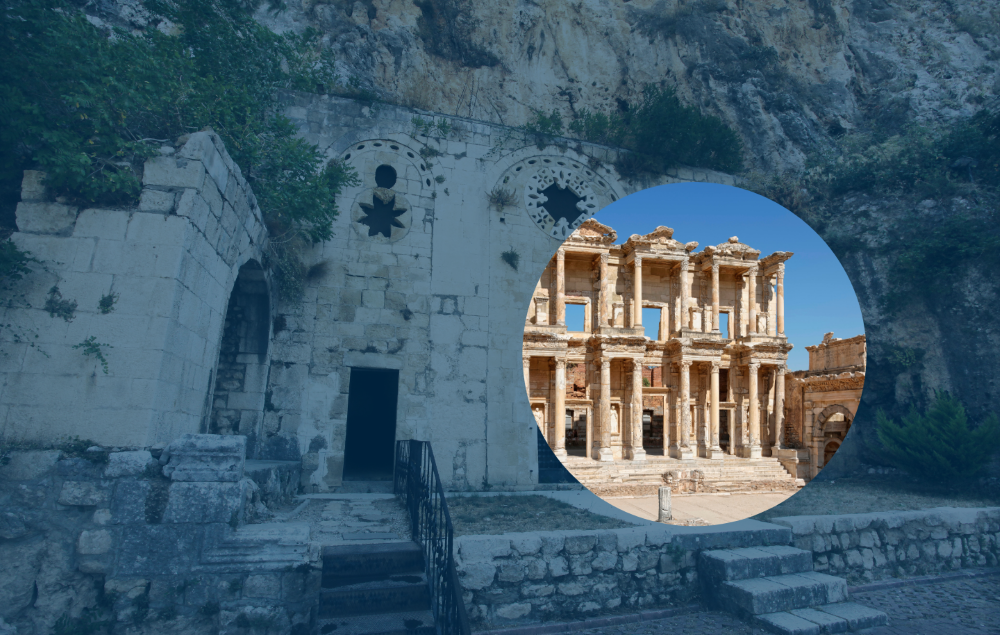
Paul: a missionary city man
The gospels mainly have the countryside as their setting. Most of
Jesus' ministry centers particularly around Galilee with the occasional
exit. The primarily agricultural examples in Jesus' parables conclude
accordingly. These examples outline a context that was recognizable to the people to whom He spoke. Jesus' ministry moves only in the latter part of His life on earth to the city of Jerusalem, the Jewish religious center of the time. Jesus dies and rises just outside Jerusalem.
After the ascension, the disciples are instructed to wait in Jerusalem for the Holy Spirit. After the outpouring of the Holy Spirit on Pentecost, the setting in Acts shifts permanently from the countryside to the city. The apostles remain in Jerusalem, and the apostle Paul also proves to be primarily a city person during his missionary ministry (Acts 8:1).
Paul chose cities of influence to establish congregations in them. If we would speak of a missionary strategy with Paul, it lies in the fact that the city was his first goal. When Paul wrote letters to congregations in the New Testament, they were primarily in the urban centers of the Roman Empire. At the end of the letter to Romans, he writes, "So from Jerusalem I traveled about as far as Illyria, preaching the gospel of Christ" (Rom. 15:19, NBG). In practice, this meant that he had planted Christian congregations in cities. These were attached to Paul and his associates by the letters he wrote and the visits they made.
Political role of cities
The city was the main site of social, political and economic life. Ferguson therefore rightly says that the Roman Empire, more than the civilizations before it, was an urban civilization. The city was the means by which the Roman Empire was governed and expanded. Where there were no cities in places where they were wanted, they were newly built on the model of Rome. One could feel as much at home in a city in Gallia (present-day France) as in Asia (present-day Turkey). Where the Romans did not need to build new cities, existing cities were renovated or expanded. Cities were the places where the future began. They were the administrative centers to govern the provinces in the empire. The importance of cities is underscored by their classification according to the privileges that had been granted to them.
The most important category of cities were the Roman colonies. In these cities mainly retired soldiers settled: Rome outside Rome. These cities were sometimes partially or completely exempted from paying taxes. Troas, Philippi and Corinth, among others, were such Roman colonies. The cities that followed in importance were inhabited by Roman citizens. These independent cities had made agreements with Rome that had to be observed. In return, they received specific privileges and the protection that came with citizenship. In turn, the "Latin" cities were below that. These cities had no special rights and were called pendariae, meaning payers of tribute. The city government was formed by a magistracy that formed the link with Rome. The magistracy consisted of elected officials who were appointed for a period of time. Finally, there were the free cities that were governed with their own drafted laws. Examples of free cities in the New Testament are Ephesus and Antioch (in Syria). Two cities that played a major role in Paul's ministry. We will now zoom in a bit more on Antioch and outline the city's role for the surrounding area.
Antioch: springboard for social renewal
The expansion of the Christian congregation outside Israel at first takes shape primarily from Antioch in Syria. This city was at this time, next to Rome and Ephesus, the most important city of the Roman Empire. It was a center of political, military and commercial influence between Rome in the west and Persia in the east and from south to north between Palestine and Asia Minor. It was home to a substantial and vibrant Jewish community. The international influence is evident in the multicultural leadership of the congregation in Antioch (Acts 13:1-3). In addition to Barnabas and Saul, three other individuals receive additional attention. Simeon is called Niger in Latin, probably because of his dark complexion. Lucius is from Cyrene, a place in North Africa.
Finally, Luke mentions Manaën, who grew up as a child with Herod Antipas, the youngest son of Herod the Great. The congregation in Antioch reflects the ethnically and culturally diverse population of the city and is made up of people from different cultural backgrounds, Ajith Fernando emphasizes in his commentary on Acts. In Paul's life, the congregation in Antioch played an important role. He worked there for quite some time and was also sent out by it (Acts 11:26; 13:2). He also returned there several times to share what God had done, to recover in body and spirit, and to prepare for another trip (Acts 14:26-28, 18:22-23).
In Paul's life, the church in Antioch played an important role.
From the multicultural makeup of the congregation, we can see that a large number of believers had come to Antioch from a different context. The city was where the governance of the region was centered. The city connected people to the rest of the world at the time. It was also a place where change was happening earlier. They were centers where people sought new challenges and or opportunities for a better life. In the city, "it happened. A monocultural village generally had a more conservative attitude and did not risk radical changes that could affect stability. Therefore, people often left for the city when they sought changes in life. Christianity brought a new message and perspective. Because of the greater openness of people in the city, there was more fertile ground in the city for this. So it is understandable that the city in particular held such an important place with Paul as a springboard for his ministry in other regions ́s in the Roman Empire.
The city as an influential center for the region
Wayne Meeks, author of the influential "The first urban Christians," calls Paul an urban man. Through Paul, the rural culture of Galilee is abandoned and the Greco-Roman city makes its appearance on the scene of gospel proclamation. The letters he writes to congregations are almost all addressed to congregations in the more influential and representative cities. Even the letter to the Galatians written to congregations in that region will have been read by believers from Ikonium, Derbe and Lystra (Acts 14:1-20). The city represented to Paul from a missionary standpoint the larger region around it. In 1 Cor. 16:19 he speaks of the churches in Asia and this will not have been just the church of Ephesus. In 2 Cor. 8:1 he speaks of the congregations in Macedonia and it is not obvious that this was then only the congregations of Philippi and Thessalonica. Philippi stood for Macedonia (Phil. 4:15), Thessalonica stood for Macedonia and Achaia (1Tes. 1:7vv), Corinth stood for Achaia (1 Cor. 16:15, 2 Cor. 1:1) and Ephesus stood for Asia (Rom. 16:5, 1 Cor. 16:19, 2 Cor. 1:8).
Paul's missionary activities were particularly focused on the city. In Corinth he lived a year and a half (Acts 18:10), in Ephesus just over two years (Acts 19:8, 10). Those in the city who had come to faith then shared the gospel with people in the region. The city contained people from different cultural backgrounds who had many lines of communication with the Gentile world. Preaching in the congregation may have helped reach people from the region (1 Cor. 14:23-25). Personal contact was also important (1Pet.3:15, Acts 21:8). For example, the church in Kenchrean may have been founded from Corinth (Rom.16:1). Epaphras founded the church in Colossae from the already existing church of Ephesus (Col.1:7-8). Several congregations in Asia Minor are also mentioned in Revelation 2-3. The fact that the city of Ephesus is mentioned first may indicate that this was the missionary center from which the other congregations had arisen without Paul's involvement. Paul applied this strategy in several cities.
The approach explains the verse at the end of the Romans letter, Rom. 15:19. Paul says he accomplished his work even though he did not have a physical presence everywhere between Jerusalem and Illyria. In Paul's experience, with the urban strategy in mind, he planted the seed in influential places from which the gospel then spread further. The congregation in a city was the means of establishing more congregations in the rural region around it. However, the choice of specific cities remains unclear. As noted, Luke and Paul do not comment on this. Therefore, no common reason can be identified. Some cities were Roman colonies, others agricultural centers, in some Greek was the primary language, others had a large Jewish community. According to Meeks, the cities have one characteristic in common and that is that they were easily accessible by land and or by sea.
Cities as religious centers of Judaism
No mention has yet been made of the Jews whom Paul always had first in mind. Paul did not only want to reach the Gentiles, he always focused first on his brethren in the faith. Even when imprisoned in Rome, even there he first made contact with the Jews, despite the opposition he had previously experienced in almost every city (Rom. 28:17, 2 Cor. 11:24). When he wanted to make them familiar with the gospel of Jesus Christ, city was the location of choice for that. It is well known that many Jews lived in the larger cities. This was especially true of Alexandria and the already discussed Antioch in Syria. According to the Jewish philosopher Philo, Jews were numerous in Asia Minor and in the area where Paul had his ministry.
Even when imprisoned in Rome, even there he first made contact with the Jews, despite the opposition he had experienced in almost every city before that.
It is known from the historian Josephus that there were many Jews in Lydia and Phrygia (Jewish Antiquities, 12.147-153). He emphasizes that this was true not only for these two specific regions, but for all of Asia Minor. Ephesus also had a significant Jewish population. Thus, there are more sources that confirm that many Jews lived in the cities. They were well integrated into city life. While visiting a city, Paul's first focus was on the synagogue he visited on the Sabbath. In addition, many worshippers of God visited the synagogues. These were people who believed in the God of Israel but were not Jews by birth (Acts 13:43, 17:4). They appeared to be particularly open to the message Paul brought (Acts 13:43, 17:4, 17:17, 18:7).
Conclusion
Paul's focus was on the city. Urban environments occupied a most important place in his missionary strategy. Openness to the gospel was greatest there because people in cities were more likely to embrace new ideas than people in rural areas. Urban people were thus more likely to be "early adopters. The multicultural urban environment provided many lines of communication to the region, allowing the gospel to spread quickly. In addition, the large cities were home to many Jews who shaped their religion there in the synagogues. Paul always tried to be the first to reach them with the gospel of the Messiah. Paul used his time and opportunities very effectively. In founding new churches, he focused only on those places where the gospel had not yet sounded (Rom. 15:20). In this way, the gospel message was quickly spread throughout the then Roman Empire with the city acting as a catalyst.
➡️ Want to learn more? Take advantage of the Study Bible app or other inspiring articles! Retrieved from our socials we also offer you fun inspiration!
This article is from a Study Bible magazine published in 2020 and was written by Haije Bergstra. Want to read more articles? Order a magazine! You can here from as little as €4.95.