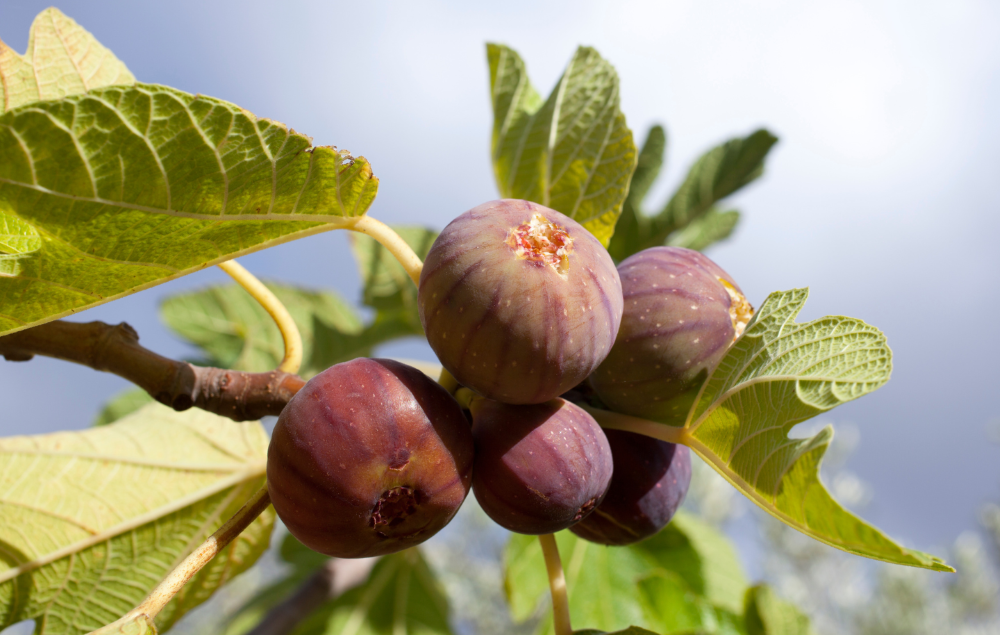
Hab. 3:17 and fig tree
One of the best known Old Testament Bible texts is found in Habakkuk 3:17 where it is stated that the fig tree will no longer bloom. This verse is interesting because, according to several Bible translations, it speaks of a fig tree blooming. Like every plant and tree, the fig tree also blooms, and it is a very special bloom called syconium.
Syconium is a hollow thickening (which we often call the fruit) where the flowers bloom on the inside. In preparing for a Bible study, I wondered if the prophet and people of that time knew about this. I looked at several books and also searched the Internet. Apart from the text in Habakkuk, I found only one vague reference. It is therefore very doubtful whether blossom is meant in our Bible text. The Hebrew word parach is translated in many other texts as “budding, sprouting,” such as in Highl.6:11and 7:12 “the garnet trees budding” (SV), but also of sores breaking open like pustules (Ex.9:9). Therefore, it seems more logical in this text to translate the word with “budding, sprouting out.” Linguistically this is correct and it does not detract from the meaning of the text. Fortunately, then, there are some translations that translate with budding, such as the NetBible “When the fig tree does not bud,“ WV95 “The fig tree does not bud“ in The Book “Though the fig tree would not bud.”.
The noun (vrl.) sukē - a contraction of sukea - means ‘fig tree.
The fig tree (Lat. ficus carica) was (and is) a very common tree in the Middle East. Unlike, for example, the olive tree (elaia), the fig loses its leaves in autumn. With the sprouting of the leaves at the end of March (cf. Mar.13:28 par.) the early figs begin to grow. These are ripe by June (see sukon ‘fig’). In summer, the tree is full of leaves (cf. Mar.11:13). In late summer, late figs begin to grow (see olunthos ‘late fig’). These tend to be larger in number and sweeter in flavor than early figs and are harvested from mid-August through October. When the fig tree was grown, it was often grown together with vines (cf. Luc.13:6; cf. ampelos ‘vine’).
In the OT, the fig tree (usually along with the vine) has several symbolic functions. First, it stands for abundance, peace and prosperity in the promised land (e.g., "the Promised Land"). 1Kon.4:25; Mi.4:4; Zech.3:10). By extension, rabbis sometimes studied Torah under vines and fig trees. Possibly this plays a role in John 1:49 (see comm.).
In other places in the OT, the people of Israel are compared to a fig tree (also in conjunction with a vine; e.g. Jer.8:13; Hos.9:10; Mi.7:1). This symbolism forms the background of several parables in which the fig tree appears (Mat.21:18-22 par; Luc.13:6-9).
Do a word study yourself? Find out how to do that here.