Part 3 of 6 of the theme 'Lessons from Nehemiah‘ by Gijs van den Brink
Last time we saw that the renewal of God's people in Jerusalem began with the calling of Nehemiah. Today we are going to see what his next step is, after being touched in his heart. He takes action and speaks to the king. We read the following in Neh.2:1-6.
| It was in the month of nisan, in the twentieth year of Artaxerxes' reign. The wine was on the table. I took the wine and offered it to the king. Never before had I appeared gloomy in his presence, but now he said, 'Why do you look so gloomy, you are not ill, are you? Something must be bothering you.' I was startled violently and said, 'Majesty, live in eternity! How would I not be gloomy when the city where my ancestors are buried has been destroyed and its gates have gone up in flames?' 'Then what is your wish?" asked the king. I prayed to the God of heaven, and answered the king: 'If it pleases the king, and if you permit me, your servant, send me to Judah, to rebuild the city where my ancestors are buried.' The king - with his favorite wife by his side - wanted to know how long my trip would take and when I would return. After I gave the king a time, he granted my request to leave. |
How beautiful this is! But do we realize that things could have gone very differently! When the king, a dictator, saw Nehemiah's gloomy face, he could also have become terribly angry and dismissed him immediately or worse. Nehemiah put his position on the line, and God saw that, and so He softened the king's heart (Neh.1:8).
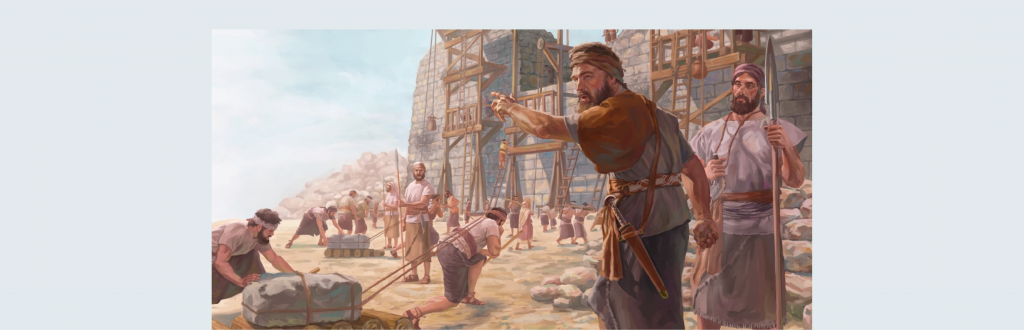
Nehemiah then travels to Jerusalem and speaks to the people there to come to a common work. We read in Neh.2:17-18 " 'I said to them, "You see what misery we are in: Jerusalem lies in ruins and the gates have gone up in flames. Let us rebuild the city wall so that we will no longer be the target of ridicule.' I told them that my God had offered me protection, and I also conveyed the king's words. 'Then let us begin rebuilding at once,' they said, and they energetically tackled the work."
It is not obvious that Nehemiah would simply connect with the people. After all, he chose a good position in the court of the Persian king over returning to Judah! Everyone knows that. How can he regain trust? Yet he succeeds because he puts himself completely on a par with the local believers: 'Come, let we ... so that we no longer be the target of ridicule .... He also gives his testimony of how God has been with him in the conversation with the king (vs. 18). It is important that the Jews in Jerusalem see that he has put his position on the line, that he has changed and renounced his initial choice to remain in Persia. The result of his honest and humble attitude is that the people decide to begin construction immediately. His open, honest and humble attitude bears fruit. Next time we will see what the third stage is.
Next time:
Part 4 of the series 'Lessons from Nehemiah' is entitled 'Organizing work‘
See also:
Part 2 of the series 'Lessons from Nehemiah' ‘Stage 1 in the renewal of a community: vocation'

Author: Gijs van den Brink
From: Study Bible Magazine
This is part 3 of 6 of the series "Lessons from Nehemiah” Some of which we will be posting online in the near future. We hope this will help you understand the Bible better!